Technical setup, creative production and Facebook Ads for the Bearproof Precision launch — NOK 15k in ad spend against ~NOK 500k in September revenue.
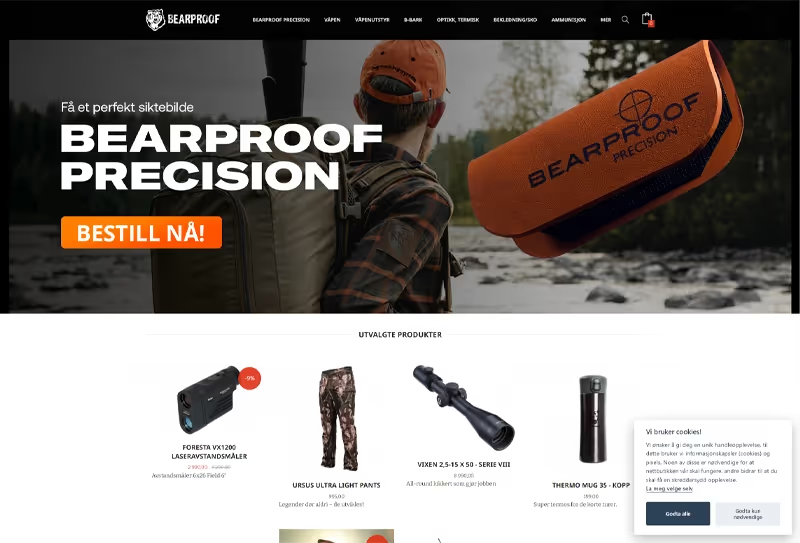
For confidential and competitive reasons, I won't go into the detailed Facebook strategy or the full marketing plan here — but the process, the results and the lessons are all below.
Bearproof had seen declining revenue since 2017 and needed help with marketing. The company had historically spent almost nothing on it — growth came organically through the Villmarksmessa trade fair, and the unique Bearproof Precision product itself had generated free press coverage (Avisa Nordland).
The managing director was genuinely interested in learning digital marketing himself, but the time required to learn and apply the knowledge made external help the more profitable option.
I started by auditing the web store to understand how the system fit together. It runs on 24nettbutikk — a Norwegian platform, which took some time to learn after working with foreign ones. It has its pros and cons, but fits this company in both price and functionality. The storefront itself was cluttered: products were poorly organized and hard to find, so I refreshed the design and restructured the product segments.
One signal stood out: sales figures for Bearproof Precision among Norwegian customers were strong. If paid advertising could push the product through at scale, it would validate growth potential for markets like Germany.

After several meetings we landed on a setup that would cut marketing cost while keeping conversion high. The services delivered:
A confused customer always says "no" — so clarity in the communication mattered more than cleverness. The content had to make the customer realize the product is necessary; the design had to be stylish but readable so first-time buyers feel comfortable and confident. Trust is the barrier for a young brand, and weak design actively undermines credibility.
Landing page. Every section was sketched on A4 paper first, then digitized in Adobe XD. A landing page is strategically built to sell — once the design was locked, I developed it in Webflow and hand-optimized the code in VS Code.
Photography & video. No studio equipment was available, so product shots were done with plain single-color backgrounds and Photoshop — which later became landing page assets. The ad video was outsourced to a partner after I moved to Oslo (my machine wasn't powerful enough to edit before September); I wrote the script and supplied the footage, and it took two revision rounds. It turned out surprisingly well.
The data layer. The landing page and product page were ready — time to launch Facebook Ads? Not quite. The Facebook Pixel and Google Analytics were installed correctly, but the Pixel never fired between the landing page and the product page — most likely because of the subdomain placement or an unresponsive web host. The fix: Google Tag Manager, which lets you manage all collection scripts through a single line of code — faster loads, better control over data distribution. The tradeoff is a lot of manual configuration compared to a standard Pixel install. GTM couldn't be integrated on the 24nettbutikk side by myself, so I contacted 24nettbutikk support and had it installed.
A detour worth taking. During my bachelor programme in autumn 2020, Knut Bjørgen — formerly of Red Gruppen, now director of brand & marketing communications at Hill+Knowlton Strategies — guest-lectured on an award-winning campaign. The method and strategy were brilliant, so I approached him afterwards and explained I was running a campaign for Bearproof. He called me the next day with feedback on the landing page: good overall, better with a few changes — and left it entirely to me whether to apply them. I noted every point, agreed with the reasoning, and shipped the revisions.
After verifying the Pixel, we were ready — and Facebook stopped us. The product is a firearm accessory, and policy section 7 states: "Ads must not promote the sale or use of weapons, ammunition, or explosives. This includes ads for weapon modification accessories." The rights lines were vague — ironically, "plastic guns, swords and toy weapons" are allowed. I submitted every ad set for manual review. It cost us a few days, but every set was accepted.
We mapped the target group with Google Trends, Facebook Audience Insights and the store's own CMS data, then split-tested audiences "scientifically" to actually understand the segments. Targeting attributes included: 18+, Hedmark / Aust-Agder / Oppland, shooting ranges, hunting and hunting teams (elk, deer, ptarmigan), nature, outdoor life.
After 3–4 weeks of advertising in September:
Order data across the last three years showed a decline — the 2017 trade-fair appearances drove spillover sales online, that activity faded, and Corona didn't help. One caveat I always apply: Facebook Ads Manager under-reports (ad blockers, connection and browser differences), so campaign numbers must be reconciled against the actual accounts and store orders — which is exactly how the ~60% was verified.
The project combined disciplines that usually require several separate vendors — design, development, photography, video, data engineering and media buying — in one loop. Problems appeared, but were resolved quickly and the project stayed on schedule.
What I'd change next time:
I expected more than 60% from NOK 15k. Analyzing the hunting industry's competitors showed email marketing is more prevalent than Facebook Ads there — cheaper and often more effective, though limited to an existing list. With the customer base now expanded, email marketing is the natural next step for Bearproof.
Finally — thanks to Bearproof for the trust and the opportunity.
[SYS.03 // ADVISORY.OPEN]
Occasional advisory, custom software architecture, and research collaboration. No sales funnel — just a direct line.
NP // NORDICPRODUCTIONS.NO