
The first big idea you learn in finance is that a krone today is worth more than a krone next year. You can invest today’s krone, and next year’s krone might buy less. From there, almost everything follows. A company, a building or a bond is worth the money it will pay out over time, adjusted for when that money arrives.
In Financial Modelling at BI, our group built a savings plan for an imaginary 23-year-old. Every deposit, withdrawal, wedding, boat, recession and boom until he turned 97 went into one spreadsheet, and we worked out how much he had to save at the start. What moved the answer most wasn’t the wedding or the kids’ college fees. It was the return, and how long it had to work.
That made me think. What happens if you look at yourself the same way?
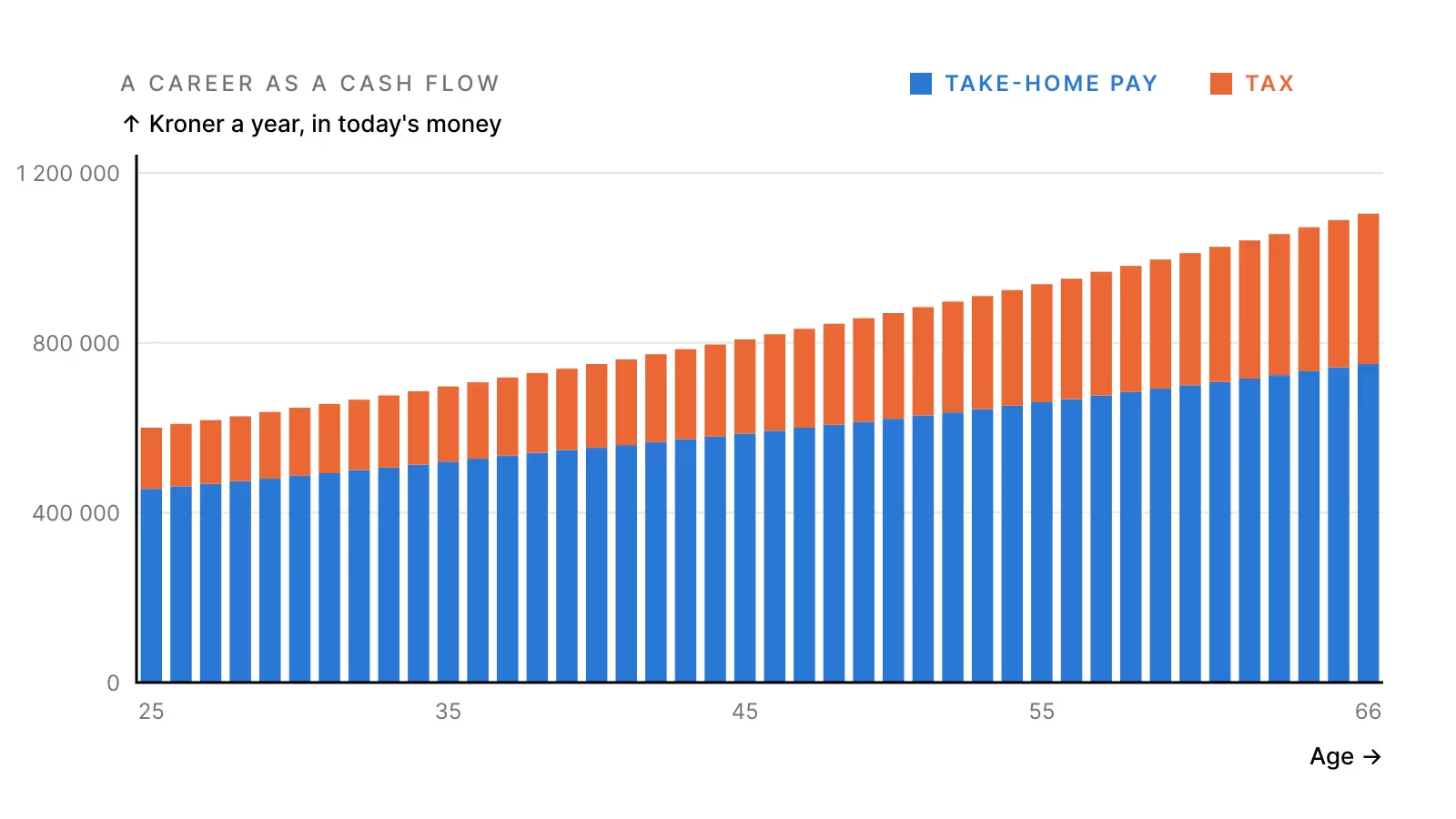
Take someone who starts working at 25 on 600,000 kroner a year, gets a raise of 1.5% a year on top of inflation, and retires at 67. In today’s money, they will earn about 34.8 million kroner over their career.
Seen from finance, that person is a cash flow, a stream of money arriving once a year for 42 years. And like any cash flow, it can be valued by discounting every year’s pay back to today. With a discount rate of 2% a year:
In a way, that’s what you are worth when you start your first job.
But you don’t own all of it. There’s a silent partner.
A career as a cash flow
Over the whole career, about 9.8 million kroner, or 28%, goes to income tax. And the partner’s share grows as you do. At 600,000 kroner you pay about 24% in total, but 33.6% on the next krone you earn. At a million, you pay about 31% in total and 46.4% on the next krone.
For an employee, the partner is also paid first. Tax comes off every payslip before the money reaches you, so everything you save and invest comes from what’s left. Compounding only ever gets to work on your share.
For someone running their own business through a limited company (an AS), the order changes. The money lands in the company, and the company pays 22% tax on its profit. After that, you decide how to get paid: as salary or as dividends.
You might think one of those is a clever way around the tax. It isn’t:
Where 100 kroner of company profit ends up
As salary, the company first pays the employer’s contribution of 14.1%, and then you pay up to 47.4% tax. As a dividend, the company pays 22% and you pay 37.84% on what’s left. That rate comes from multiplying the ordinary 22% by 1.72, a factor Norway uses to tax dividends harder:
That’s almost exactly the same, and it’s on purpose. Norway’s tax system is designed so that owners can’t dodge tax by choosing one route over the other. At normal income levels salary is actually cheaper, and it gives you pension and sick pay rights as well.
So the company doesn’t make the total tax smaller. What it changes is when you pay it.
Here’s the key rule. When a company owns shares and earns money on them, that money is almost tax-free inside the company. This is called the exemption method (fritaksmetoden). The personal tax of 37.84% is only paid when the money leaves the company and reaches you.
So money you leave in the company keeps working, with the tax still inside it. It’s like an interest-free loan from the state with no fixed repayment date. And as our savings model showed, what matters most for a long-term saver is how much money is working and for how long.
To see what that’s worth, say your company has one million kroner left over after it has paid its 22% tax, and it grows by 7% a year. You have two choices:
The lines show how much you would have after all tax if you cashed out in a given year:
One million kroner, two ways to save it
After 30 years, keeping the money in the company leaves you with 3.85 million kroner, against 3.18 million for paying it out first. That’s about 21% more, from the same money and the same tax rates. The whole difference comes from the 378,400 kroner of dividend tax that stayed invested for 30 years instead of being paid on day one. Without the running costs, the company route would have ended at 4.7 million.
For the curious, here’s the whole comparison in two lines. is the million kroner, the yearly return, the number of years and the dividend tax of 37.84%:
The second line is smaller by exactly the tax on the gains. When you pay out first, you pay dividend tax up front and then tax on the gains as well. In the company, the dividend tax at the end is the only tax you pay.
It isn’t free money, and it isn’t for everyone.
This is inspired by Financial Modelling in Practice (FIN3616) and Basic Financial Management (EXC2110) at BI Norwegian Business School, where we built savings plans and valued cash flows over time.
The numbers use the Norwegian tax rules for 2026, simplified. The salary tax includes the national insurance contribution, bracket tax and the standard deductions. The examples ignore the tax-free allowance on shares (skjermingsfradrag), and returns won’t be a steady 7% in real life. This is an illustration, not financial advice. Talk to an accountant before you set up a company for this.
[SYS.03 // ADVISORY.OPEN]
I take on the occasional advisory job, custom software architecture and research collaboration. There's no sales funnel. You write to me and I answer.
NP // NORDICPRODUCTIONS.NO