
Firi: how a Norwegian crypto exchange won people's trust
In the Financial Technology course of my bachelor’s degree at BI, our group got to pick a fintech company and take it apart: where it came from, how it works, how it makes money, and what could trip it up. We picked Firi, Norway’s biggest crypto exchange.
A crypto exchange is a marketplace. You put in Norwegian kroner and buy Bitcoin or another cryptocurrency, or you sell and take the kroner back out. Firi sits in the middle, much like a bank does when you swap kroner for euros.
Firi was founded in 2017 by Thuc Tuan Hoang and Øyvind Kvanes. When we wrote the paper in autumn 2024, it had over 240,000 users in Norway, had just opened in Denmark and was planning to launch in Sweden. All the numbers in this article are from that time.
A hard place to start
Starting a crypto company in Norway in 2017 meant fighting on three fronts at once.
Nobody understood it. Most people saw crypto as complicated and risky, almost no shops accepted it, and there was little to read about it. A crypto company had to build its product and teach people what crypto was at the same time. That takes time and money most startups don’t have.
There were no clear rules. Crypto exchanges operated in a legal grey zone. Worse, several banks were worried about money laundering and refused crypto companies even a normal bank account. Over time that changed. As the market grew, banks started competing for these customers, and some even invested in crypto exchanges themselves.
Hackers loved exchanges. An exchange holds a lot of other people’s money in one place, which makes it an obvious target. One break-in could wipe out both the funds and the trust. Good security wasn’t a nice extra. It was the price of being in the business at all, and it kept many smaller players out.
How it works for you
We walked through Firi as a normal user would.
Signing up. You register with Vipps or in the Firi app. Firi checks who you are and that you’re over 18, like a bank does. This is required by law to stop money laundering.
Putting money in. The quickest ways are Vipps, a card or Apple Pay. You can also pay straight from your bank account through services like Neonomics and Tink. That’s possible because of an EU rule (PSD2) that lets approved companies start payments from your bank with your permission. A normal bank transfer also works, just more slowly.
Buying. Beginners get a simple view with a buy button. More experienced traders can switch to an advanced view with live prices and the option to set the price they want to pay. People who want to save a little every month can set up an automatic monthly purchase. And anyone investing more than a million kroner gets a personal trading desk that handles big orders without moving the price.
Taking money out. Kroner go back to your bank account within one to three working days. Crypto can be sent to another wallet, usually faster.
Why people trust it
Trust was Firi’s hardest problem, so a lot of the company is built around it.
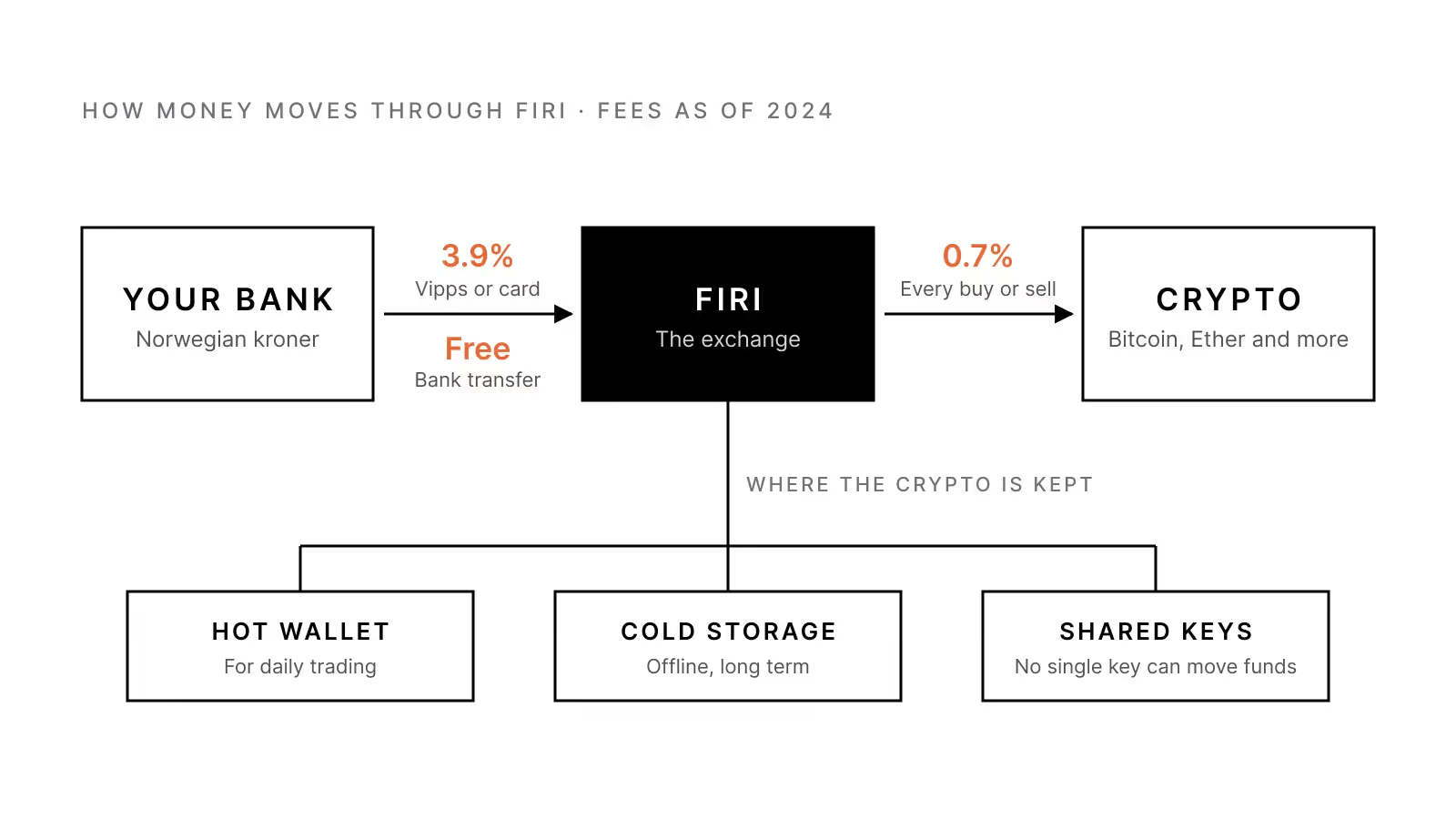
- Your crypto is kept in layers. A small part sits in a “hot wallet” online for day-to-day trading. Most of it is kept offline in “cold storage”, out of reach of hackers. On top of that, Firi uses a system from the company Fireblocks where the key to the funds is split into pieces, so no single person or computer can move the money alone.
- Anyone can check the balance. Firi’s main crypto wallets are public. After the collapse of the big exchange FTX in 2022, where customers’ money turned out to be missing, being able to see that the money is actually there matters a lot.
- It follows Norwegian rules, and customer funds are insured.
- Tax is made easy. Firi creates a ready-made report for Skatteetaten, the Norwegian tax authority, which is otherwise one of the most annoying parts of owning crypto.
- It teaches. Firi publishes plain articles explaining how the different cryptocurrencies work, so beginners aren’t left guessing.
Vipps login, familiar ways to pay and Norwegian rules together make crypto feel less like the Wild West.
How Firi makes money
Firi earns its money from fees, a small cut of almost everything that happens on the platform.
What it cost to use Firi in 2024
View data
The biggest earner is the 0.7% fee on every buy and sell. Topping up with Vipps or a card costs 3.9%, while a bank transfer is free.
Firi also has a few other sources of income:
- Direct Trade, a way to trade with stable prices, even in large amounts. It made up 30 to 35% of revenue in mid-2024, and Firi aims to grow that to 70 to 80% by the end of 2025.
- Staking, where you let your coins help run networks like Ethereum and Cardano and earn a reward in return. In early 2024, more than 20,800 users were staking, with over 9,200 Ether in total. It also gives people a reason to stay on the platform.
- The trading desk for large investors and companies.
It adds up. Firi reported revenue of 56 million kroner in the first quarter of 2024, up 300% from the same quarter the year before.
What could go wrong
Firi was clearly doing well, but we saw four risks.
The rules keep getting stricter. Firi has to follow the Norwegian Financial Supervisory Authority (Finanstilsynet) and the EU’s new crypto law, MiCA. Checking every customer’s identity and watching for money laundering costs more as the user base grows, and in early 2024 Firi already had 232,000 users. Tax rules for crypto also keep changing.
Payments cost money. Vipps, BankID and bank payment services all charge Firi for every transaction. For a company that lives on small fees, those costs eat directly into the margin.
The giants are out there. Coinbase and Binance have far more money and reach. Firi’s answer is being local, and it’s working: among exchanges based in Norway, Firi’s market share grew from 70% to 90%.
Firi's share among Norwegian crypto exchanges
View data
Crypto goes up and down. When prices rise and everyone is trading, Firi earns a lot. When the market goes quiet, so does the revenue. A business built on trading fees rides the same rollercoaster as the coins themselves.
What I take from it
- Trust is the product. Anyone can let people buy Bitcoin. Firi’s real work was making it feel safe: Vipps, Norwegian rules, public wallets and a tax report you don’t have to think about.
- Local beats big, sometimes. Against global giants with far more money, being Norwegian turned out to be the advantage.
- Watch what the money depends on. Firi’s income follows how busy the market is, so a good year can be followed by a quiet one. Its push towards Direct Trade and staking reads like an attempt to depend less on that.
About the paper
This is based on a group project in Financial Technology (EBA3600) at BI Norwegian Business School, autumn 2024. We used Firi’s own website and its investor updates for the first and second quarters of 2024. You can read the full paper with the button next to this article.
[SYS.03 // ADVISORY.OPEN]
Stuck on a hard technical problem? Maybe I can help.
I take on the occasional advisory job, custom software architecture and research collaboration. There's no sales funnel. You write to me and I answer.
NP // NORDICPRODUCTIONS.NO